

Protein intake after concurrent exercise to enhance muscle protein synthesis
What is the effect of protein intake after acute exercise on muscle protein synthesis?

Title of publication: Myofibrillar and Mitochondrial Protein Synthesis Rates Do Not Differ in Young Men Following the Ingestion of Carbohydrate with Milk Protein, Whey, or Micellar Casein after Concurrent Resistance- and Endurance-Type Exercise.
Authors: Churchward-Venne, T. A., Pinckaers, P. J. M., Smeets, J. S. J., Peeters, W. M., Zorenc, A. H., Schierbeek, H., Rollo, I., Verdijk, L. B., & van Loon, L. J. C. Journal: The Journal of nutrition, 149(2), 198–209.
Year: 2019
Background:
Consuming protein after strength training at the gym is a common practice. The idea behind this nutritional strategy is to promote recovery and give your muscle growth (hypertrophy) an extra boost, provided you do it consistently. Plenty of research supports this. But what if you change the type of workout you do? Instead of exclusively lifting weights (strength or resistance training), you can combine your session with some cardio. This type of training is called concurrent training. Past research has shown that when you add cardio to your strength training, the signal that activates cardio in the muscle negatively influences the signal that activates strength. This could negatively impact your strength and hypertrophy (1). This phenomenon is called the interference effect. Although this effect has not been clearly established, it would be interesting to investigate whether consuming protein after concurrent training is still beneficial for acutely stimulating muscle growth (muscle protein synthesis).
What was done:
In this large-scale study, conducted at Maastricht University, fit and healthy participants arrived in the morning in a fasted state. An IV was inserted for the first part of the experiment. The administered solution contained labeled amino acids. After a stabilization period, the participants began their concurrent training: 4 sets, 8-12 repetitions at 80% of their 1RM of leg press and leg extension exercises. This was followed by 30 minutes of cycling at a steady but vigorous pace. Immediately after the exercise, a muscle biopsy was taken, and the participants were given a recovery drink.
What was in this recovery drink?
The study was designed to investigate whether different protein sources would stimulate protein synthesis to varying degrees. All participants received 45 grams of carbohydrates in their drink, but depending on the group they were randomized to, the drink either contained nothing (control group), or 20 grams of milk protein, 20 grams of whey protein, or 20 grams of casein protein. Milk consists of both whey and casein (20/80 split), so it would be interesting to investigate whether one type of protein in milk is superior to the other when consumed separately.
How was muscle synthesis measured?
Blood samples were taken regularly over a six-hour period, and two additional muscle biopsies were taken. These methods allow us to study how much and how quickly the labeled amino acids are incorporated into the leg muscles. The more found in the muscle, the higher the muscle protein synthesis. However, muscles consist of many components, so it is also interesting to see whether the labeled amino acids are incorporated into different components. The main components of interest are: myofibrillar protein (a scientific term for the components directly involved in muscle contraction – associated with strength training) and mitochondrial protein (the component where the cell produces energy – associated with endurance training).
Results/What we found:
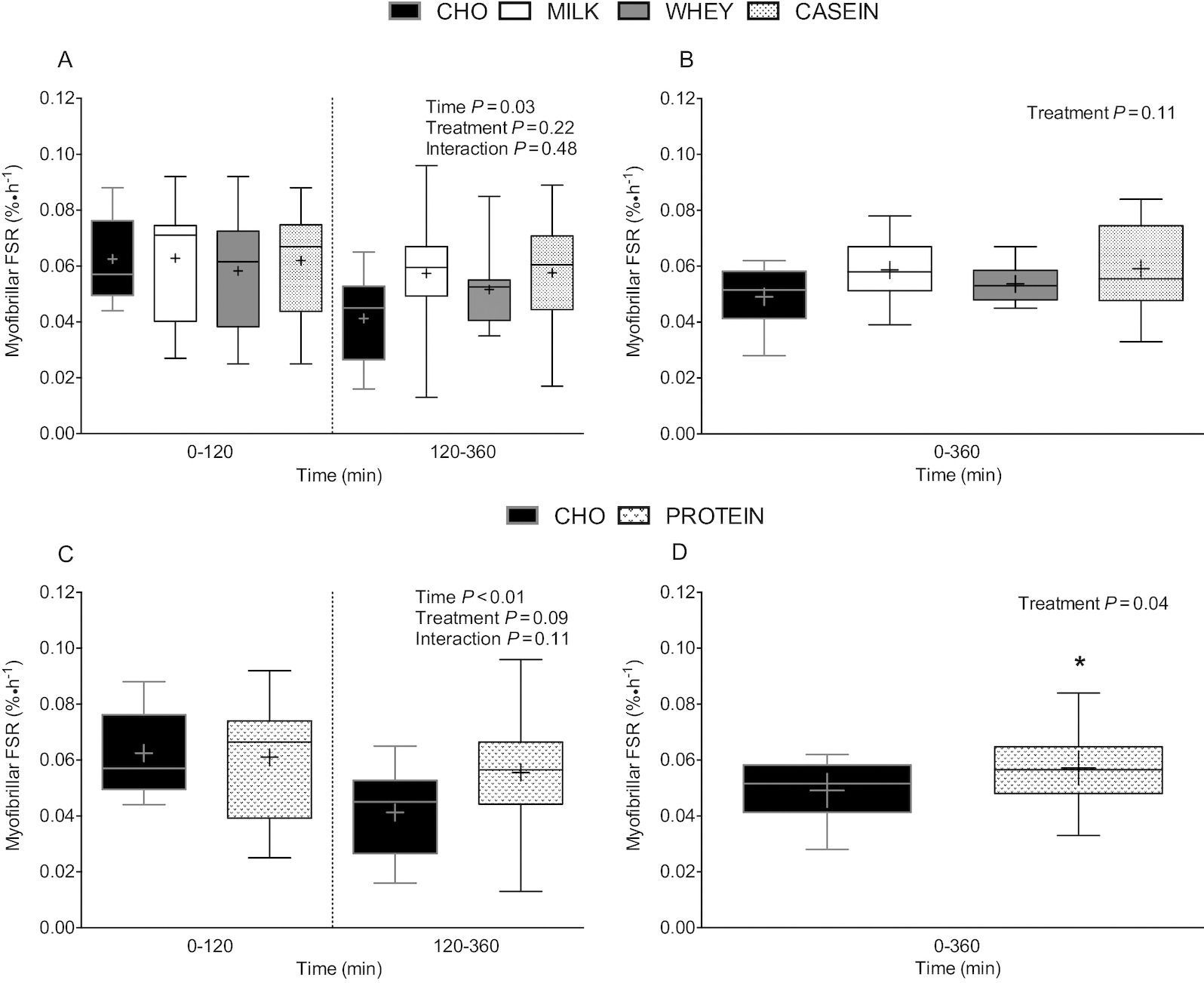
For myofibrillar protein synthesis (i.e., strength/hypertrophy), when comparing each individual group, there were no differences between the control group (CHO only), milk protein, whey protein, or casein protein. However, when the data from the protein groups were pooled, myofibrillar protein synthesis was higher than that of the control group. For mitochondrial protein synthesis, no differences were observed between each individual group or between the control and protein groups when these groups were pooled.
What does this mean in practice?
Consuming milk protein (20 grams) after training with both strength and endurance increased the rate at which new myofibrils were formed (strength/hypertrophy), but not the rate at which new energy factories were created (endurance).
Technical note in simple terms: labeled amino acids?
Think of it this way: All amino acids in the body (including those that also circulate in the blood) are white. The labeled amino acid is colored red. And by sampling body fluids and tissues over time, you can trace where the labeled (red) amino acid goes.
Personal reflection:
This project was part of my master's degree in human movement sciences. Although I had already done a research project for my bachelor's degree, this project gave me great insight into the wonderful world of applied research. The days were long (starting at 7:00 a.m. to prepare for an experiment, finishing by 4:00-5:00 p.m.), but I loved the scientific aspect: collecting and processing human samples (working with liquid nitrogen was fun), reporting the results, leading the exercise session, and making the participants feel comfortable.
References:
(1) Wilson, J. M., Marin, P. J., Rhea, M. R., Wilson, S. M., Loenneke, J. P., & Anderson, J. C. (2012). Concurrent training: a meta-analysis examining interference of aerobic and resistance exercises. Journal of Strength and Conditioning Research, 26(8), 2293–2307. https://doi.org/10.1519/JSC.0b013e31823a3e2d
Link to original study: